
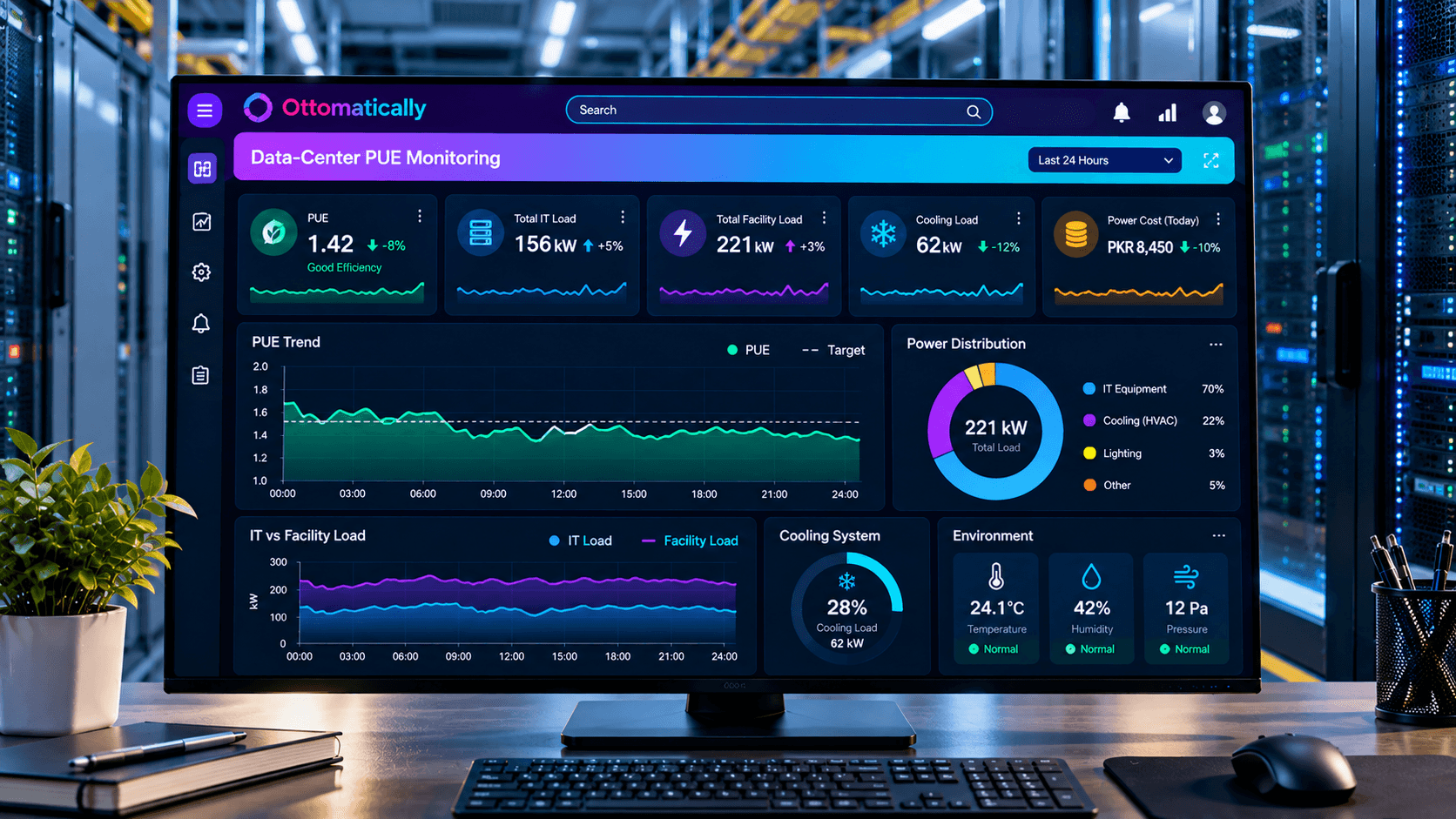
Understanding Where Data-Center Energy Goes
Servers, storage, and networking equipment need electricity to deliver IT services. Keeping them operational also requires cooling, power conversion, distribution, and other supporting infrastructure.
Power Usage Effectiveness, or PUE, helps operators understand the relationship between these energy requirements.
The Green Grid defines PUE as total data-center energy divided by the energy consumed by its IT equipment. It provides a useful starting point for tracking infrastructure efficiency.
For operators, the practical question is: how much supporting energy does the facility require to operate its IT equipment, and where can that overhead be improved?
How to Calculate PUE
PUE = Total data-center energy ÷ IT equipment energy
Both measurements must cover the same period and use consistent units.
Consider this illustrative monthly example:
Measurement | Energy |
|---|---|
Total data-center energy | 16,000 kWh |
IT equipment energy | 10,000 kWh |
Supporting infrastructure energy | 6,000 kWh |
PUE | 1.60 |
For every 1 kWh consumed by IT equipment, the facility uses another 0.60 kWh in supporting infrastructure.
That overhead represents 37.5% of total facility energy, not 60%. It includes necessary services such as cooling and electrical losses, so it should not all be labelled waste.
A value closer to 1 indicates less infrastructure overhead relative to IT energy. It does not, by itself, establish how productively the IT equipment is being used.
Define the Measurement Boundary
A meaningful PUE calculation starts with a clear boundary.
For a dedicated data center, total energy should capture the facility’s IT and supporting infrastructure. For a server room inside a factory or office building, the entire building’s electricity consumption would usually include unrelated loads.
IT measurement points also matter. A UPS output reading can include downstream losses or non-IT equipment. These must be understood and accounted for when interpreting the result.
Industry measurement guidance emphasizes consistent boundaries and documented measurement locations, especially for mixed-use facilities.
Before calculating PUE, establish:
- Which facility loads are included.
- Where IT energy is measured.
- How shared cooling is measured or allocated.
- How backup and other energy sources are accounted for.
- Which readings are measured and which are estimated.
An estimate can support an initial investigation, provided its assumptions remain visible.
Separate Live Indicators From Annual Reporting
A ratio of simultaneous facility power to IT power can provide an operational snapshot. It may help identify changes during the day, but it is different from an annual energy-based result.
The U.S. Department of Energy’s design guidance defines PUE using annual energy consumption. Annual measurements account for seasonal cooling conditions and changes in IT load.
For reporting, calculate the ratio from the accumulated energy totals:
Annual PUE = Total annual facility energy ÷ Total annual IT energy
Avoid taking a simple average of daily or monthly PUE values. Periods with different IT energy consumption carry different weights.
Label dashboard values clearly—for example, current power ratio, monthly energy-based PUE, or annual PUE.
Interpret Changes Alongside Energy Consumption
A lower PUE does not always mean lower total electricity consumption.
If IT demand increases while supporting energy remains similar, PUE can improve even though the facility consumes more electricity.
Conversely, reducing IT energy can increase PUE when cooling and other overhead do not fall proportionately. The facility may still have achieved an overall energy reduction.
Review PUE alongside:
- Total facility energy.
- IT equipment energy.
- Supporting infrastructure energy.
- IT load and workload context.
- Outdoor conditions and cooling operation.
PUE describes infrastructure efficiency. Its formula does not measure useful computing output, water consumption, carbon emissions, or service availability. These require additional indicators.
Use Monitoring to Investigate Cooling Overhead
When supporting energy rises, operators need enough information to investigate the cause.
Useful measurements can include cooling-system energy, rack inlet temperatures, humidity, equipment states, and IT load.
The Department of Energy’s best-practice guidance covers air management, cooling, electrical systems, and IT environmental conditions as areas for improving data-center energy performance.
A practical investigation might examine:
- Cooling equipment running during low-load periods.
- Air bypassing the IT equipment.
- Hot exhaust air returning to equipment inlets.
- Changes in cooling performance after maintenance.
- Electrical losses under different loading conditions.
Any adjustment should preserve equipment operating requirements and the facility’s required redundancy.
Measure the Result of an Improvement
Using the earlier example, suppose supporting energy falls from 6,000 kWh to 5,000 kWh while IT energy stays at 10,000 kWh.
Total energy becomes 15,000 kWh, and PUE improves from 1.60 to 1.50.
The measured reduction is 1,000 kWh, or 6.25% of the original total energy. This is an illustrative calculation, not a reported project result.
Comparisons should account for changes in IT load, weather, measurement coverage, and operating requirements.
Connecting Data-Center Monitoring With Linked Things
Linked Things’ Smart Data Center solution brings together monitoring of power, environmental conditions, cooling, and operational alerts. These capabilities help teams review supporting infrastructure alongside equipment conditions.
A PUE implementation additionally requires suitable facility and IT energy measurements, a documented boundary, and consistent reporting periods. The available calculation depends on the installed metering and data coverage.
Start With a Reliable Baseline
Begin by mapping energy flows and verifying the measurement points. Record facility energy, IT energy, environmental conditions, and cooling operation over a representative period.
Investigate one improvement opportunity, record the intervention, and compare the results under similar conditions.
PUE becomes useful when teams can trace a change in the ratio back to measured energy and operating conditions. To discuss data-center monitoring and efficiency requirements, contact Linked Things.