Understanding the Electricity Behind Equipment Performance
A production machine trips without an obvious mechanical fault. A motor runs unusually hot. Electronic controls reset intermittently, while the electricity bill appears normal.
These symptoms can justify investigating power quality. Disturbances in voltage and current may disrupt equipment even when the facility continues receiving electricity.
Fluke identifies voltage disturbances and harmonic currents as major areas of power quality investigation. Comparing electrical measurements with equipment operating histories helps teams assess the cause and severity of a problem.
For industrial operators, power quality monitoring provides evidence to investigate interruptions, prioritize corrective work, and verify whether an intervention has helped.
What Is Power Quality Monitoring?
Power quality monitoring measures electrical supply characteristics and disturbances over time.
Energy monitoring answers questions about consumption: how much electricity was used, when, and by which load. Power quality monitoring examines the electrical conditions under which that consumption occurred.
IEC 61000-4-30 defines measurement methods for power quality parameters in 50 Hz and 60 Hz AC systems, including voltage variations, interruptions, unbalance, harmonics, and frequency.
The measurements required depend on the operational problem and the equipment being investigated.
Which Conditions Should Be Monitored?
Condition | What it describes | What to investigate |
|---|---|---|
Voltage dips or sags | A temporary reduction in voltage | Whether the event coincides with equipment trips or control resets |
Voltage swells | A temporary increase in voltage | Switching events and the affected equipment’s response |
Interruptions | A loss or near-loss of supply voltage | Duration, affected circuits, and recovery behaviour |
Harmonic distortion | Waveform components at multiples of the fundamental frequency | Nonlinear loads and their contribution to electrical distortion |
Phase unbalance | Unequal conditions across a three-phase system | Supply conditions, connections, and load distribution |
Transients | Brief, rapid voltage disturbances | Switching activity and other possible disturbance sources |
Fluke’s troubleshooting guidance recommends examining harmonics, unbalance, and disturbance patterns when investigating electrical symptoms. These measurements guide diagnosis; an abnormal value alone does not establish the cause of a failure.
Harmonics: Looking Beyond Average Readings
Equipment such as variable-frequency drives, rectifiers, and electronic power supplies can draw nonlinear current. This can introduce harmonics into the electrical system.
Harmonic-related problems can include additional heating and disruption to equipment operation. Investigation should consider the loads, measurement location, and individual harmonic components rather than relying only on one total distortion value.
Voltage distortion and current distortion describe different conditions. The dashboard should identify which quantity is being reported and how it was measured.
Capture Events Where They Occur
A brief disturbance may be missed by a system that uploads one average reading every minute.
Power quality analyzers can capture events such as dips, swells, and transients locally, alongside voltage, current, and power measurements. The available capture functions depend on the instrument and model.
A connected implementation should therefore separate:
- Local measurement: Detect and record disturbances at the electrical installation.
- Data transfer: Send available trends and event records to the monitoring platform.
- Operational analysis: Compare events with machine states, alarms, and maintenance records.
Sending meter readings more frequently cannot create capabilities that the meter does not have.
Connect Electrical Events With Production Events
Consider a production line that repeatedly stops when a large motor starts elsewhere in the facility.
A practical investigation could:
- Record the electrical conditions at relevant measurement points.
- Capture motor-start and production-stop timestamps.
- Check whether the events repeatedly coincide.
- Review equipment fault logs and operating conditions.
- Measure again after corrective work.
A repeated timing relationship helps focus the investigation. Further measurements are needed to determine whether the problem originates in the supply, distribution system, or connected loads.
Synchronizing timestamps makes these comparisons more useful.
Make Dashboards and Alerts Actionable
A useful dashboard should help the team move from a summary to the underlying evidence.
Recommended information includes:
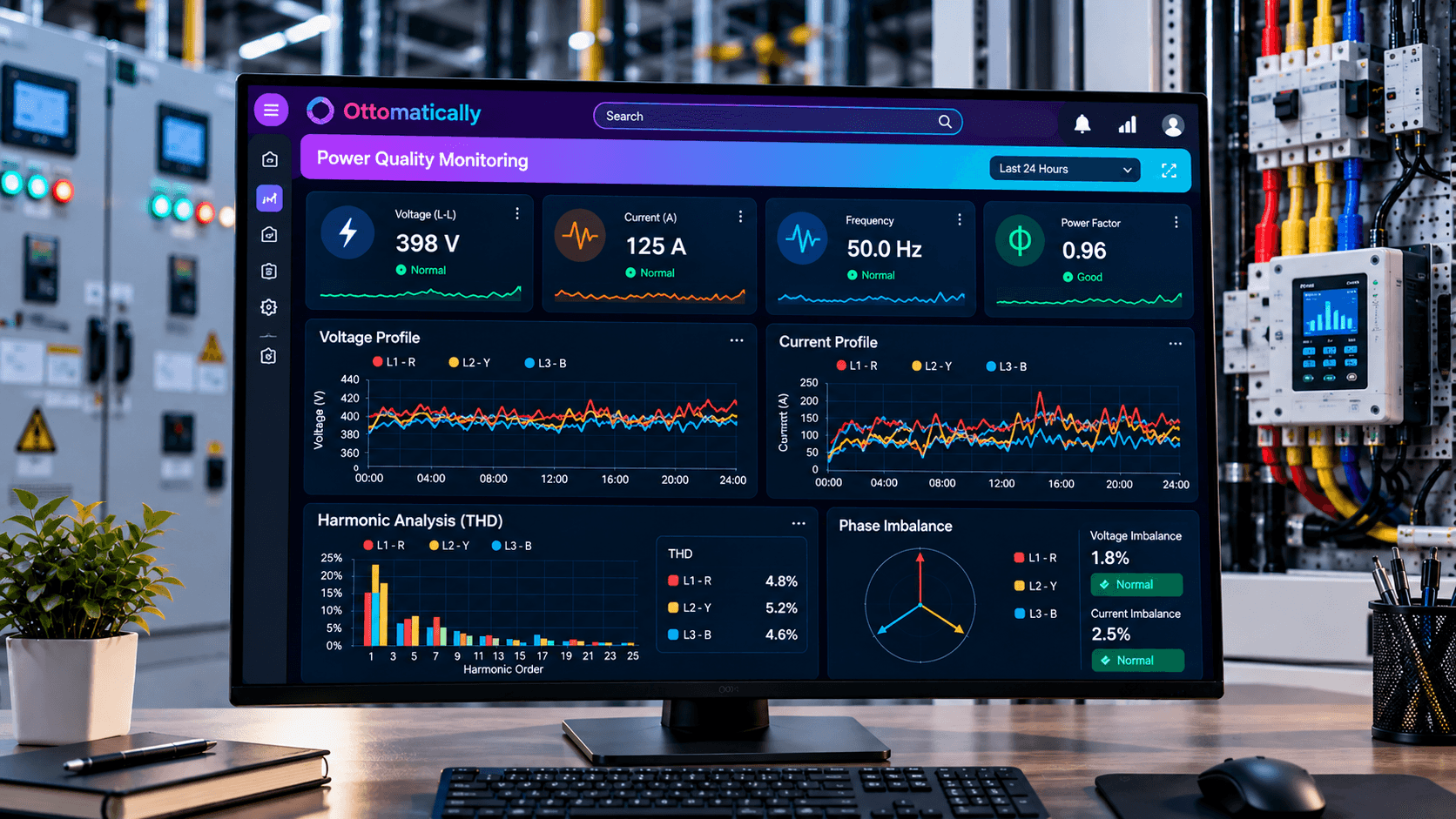
- Phase voltage and current trends.
- Frequency and supported distortion measurements.
- Event type, timestamp, duration, and affected phases.
- Measurement location and related equipment.
- Data freshness and communication status.
- Relevant machine alarms and operating states.
Alerts should provide enough context for an assigned person to investigate. Thresholds should reflect equipment requirements and applicable assessment criteria.
Power quality monitoring supports diagnosis and response. Equipment protection still depends on the appropriate electrical protection devices.
Choose Measurement Methods for the Purpose
A general-purpose energy meter may support some power quality indicators without providing detailed disturbance capture.
IEC 61000-4-30 describes Class A and Class S measurement methods. It defines how measurements are made; it does not establish one universal acceptable limit for every installation.
Before implementation, confirm:
- Required parameters and event-capture functions.
- Measurement class and accuracy.
- Sensor and instrument suitability.
- Local recording and data-export capabilities.
- The criteria against which results will be assessed.
Connecting Power Quality With Linked Things
Linked Things’ Smart Energy solution provides energy monitoring and threshold alerts for connected operations. These capabilities can complement power quality measurements by connecting electrical information with operational dashboards.
The parameters available to the platform depend on the connected meter or analyzer and its supported interface. Detailed power quality analysis requires suitable measurement equipment and access to the relevant records.
Start With a Critical Circuit
Begin with an asset or circuit experiencing a recurring problem, such as unexplained trips, overheating, or intermittent resets.
Agree on the measurements needed, capture a representative operating period, and compare electrical events with equipment behaviour. Record corrective actions and verify the results before expanding monitoring.
Power quality monitoring is most useful when electrical events can be traced to operational consequences. To discuss monitoring requirements for your facility, contact Linked Things.